


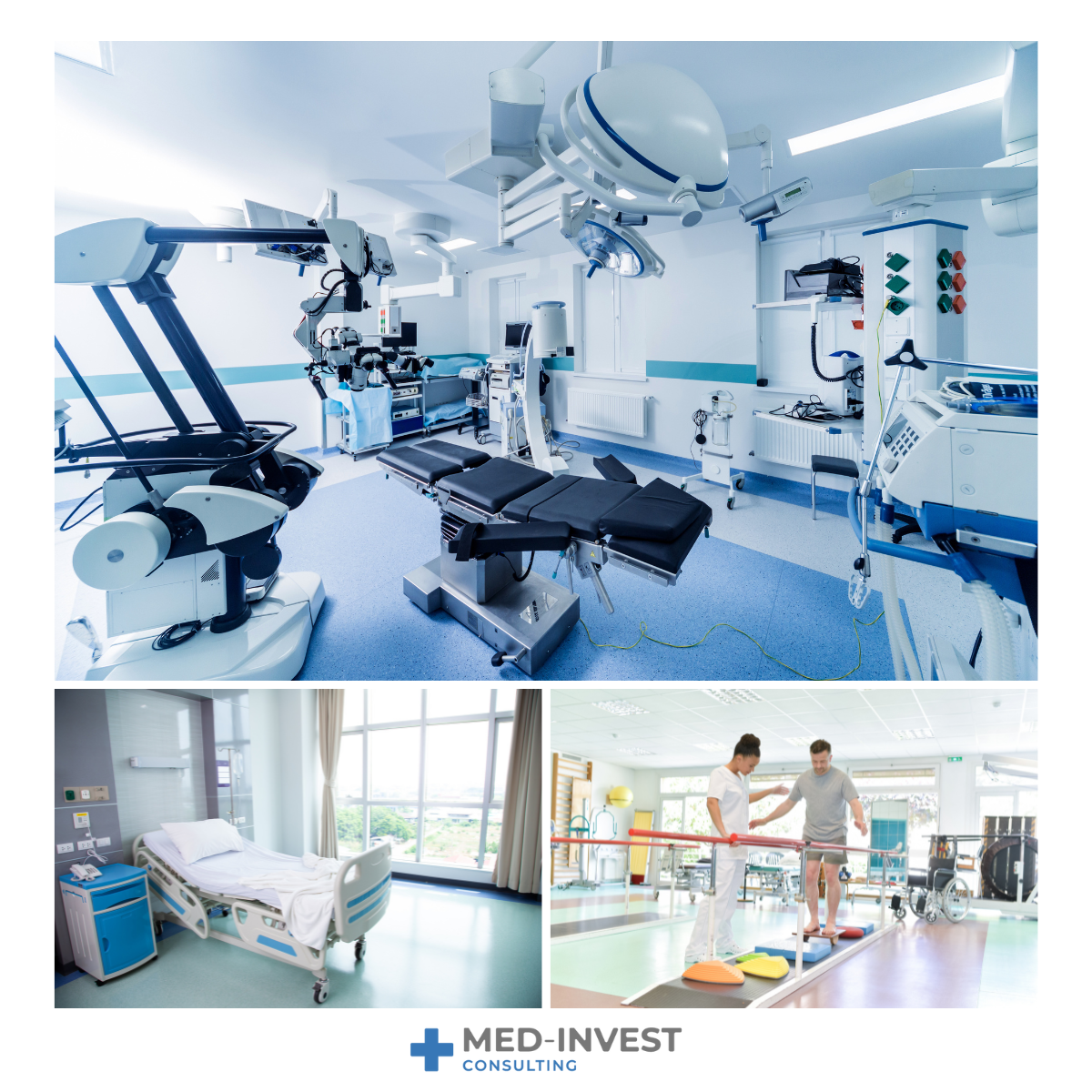
Opening a medical facility (hospital, clinic, outpatient center, or nursing home) is a complex task and a significant challenge, requiring broad knowledge both in medicine and project management.
One of the most important aspects of this process is infrastructure, which includes buildings, equipment, and technology. Equally important is the project team, without which opening a new facility would not be possible.
When preparing to open a medical facility, it is crucial to plan the entire process carefully to create a functional and modern place that provides the best care for patients.
Here are the key steps to consider:
1. Budget and careful planning of the entire process.
Before planning the opening of a new medical facility, it is important to decide how the investment will be financed. Will it be funded internally, or with external support such as grants and EU funds, bank loans, private investors (venture capital, business angels), stock or bond issuance, or a public-private partnership (PPP)?
Proper early planning, including preparing a schedule and tracking expenses, allows for effective and timely project management.
Opening a small outpatient clinic differs from opening a hospital or care home in terms of scale, cost, and timeline.
Even the best-planned project can face unexpected delays, such as construction overruns, equipment deliveries, furniture installation, or staff recruitment.
Opening a medical facility also requires compliance with numerous formalities and obtaining permits from:
– State Sanitary Inspection
– Labor Inspection
– Fire Department
– Environmental Protection Inspection
– National Health Fund (contracting services)
– Regional Authorities (permission to operate a medical facility)
– Local Municipality (construction permits)
It is wise to include a time buffer, as in about 90% of cases delays occur that are beyond the project manager’s control – typically 1–2 months.
2. Needs analysis and location selection.
The next step is choosing the right location.
Conduct an analysis of the local market – what medical services and specializations are in demand?
A demographic analysis will help determine whether the area is dominated by children, elderly people, or a mixed population.
The facility should be easily accessible for patients, preferably in a central location, with convenient transport and sufficient parking, which is especially important for older adults or those with mobility challenges.
3. Facility and interior design.
Designing a medical facility is a critical stage, requiring close collaboration with an architect to ensure functional spaces and comfort for both patients and staff.
Consult rooms, reception, waiting areas, and treatment rooms must be well planned to allow smooth workflow.
Involving future staff – doctors, nurses, facility managers – is valuable because they understand operational needs best.
Facilities must comply with legal and sanitary requirements and be accessible for people with disabilities. Collaborating with architects specializing in medical facilities is recommended.
Biophilic design
Modern medical design increasingly incorporates biophilic elements – wood, stone, plants, natural light, and views of greenery. Studies show that such environments reduce stress, improve focus, and accelerate patient recovery.
4. Medical equipment.
Medical equipment is a key element of a facility’s success.
Preparing equipment specifications early in the project with medical staff allows optimization of costs and delivery schedules.
Purchases should be made with the help of experts familiar with the medical technology market, paying attention to:
-
Service conditions
-
Maintenance schedules
-
Response times in case of failure
A well-structured supplier contract can prevent operational downtime.
5. Modern technologies, AI, and sustainability.
Modern facilities increasingly use IT systems to manage patient data, documentation, and administrative processes, often incorporating AI. Ensuring data security (GDPR) in both electronic and paper formats is essential.
Sustainability is not just a trend but a necessity. Consider:
-
Eco-friendly materials
-
Energy-efficient heating and cooling systems
-
Renewable energy sources
-
Medical waste management and recycling
AI is no longer just a trend; the medical sector is leveraging it wherever possible.
Opening a medical facility is a complex process requiring planning, expertise, and practical knowledge. A competent team, precise budget management, project coordination, and attention to detail are crucial.
With proper preparation and professional organization, a newly opened facility can become a trusted, patient-friendly place valued by the local community.