


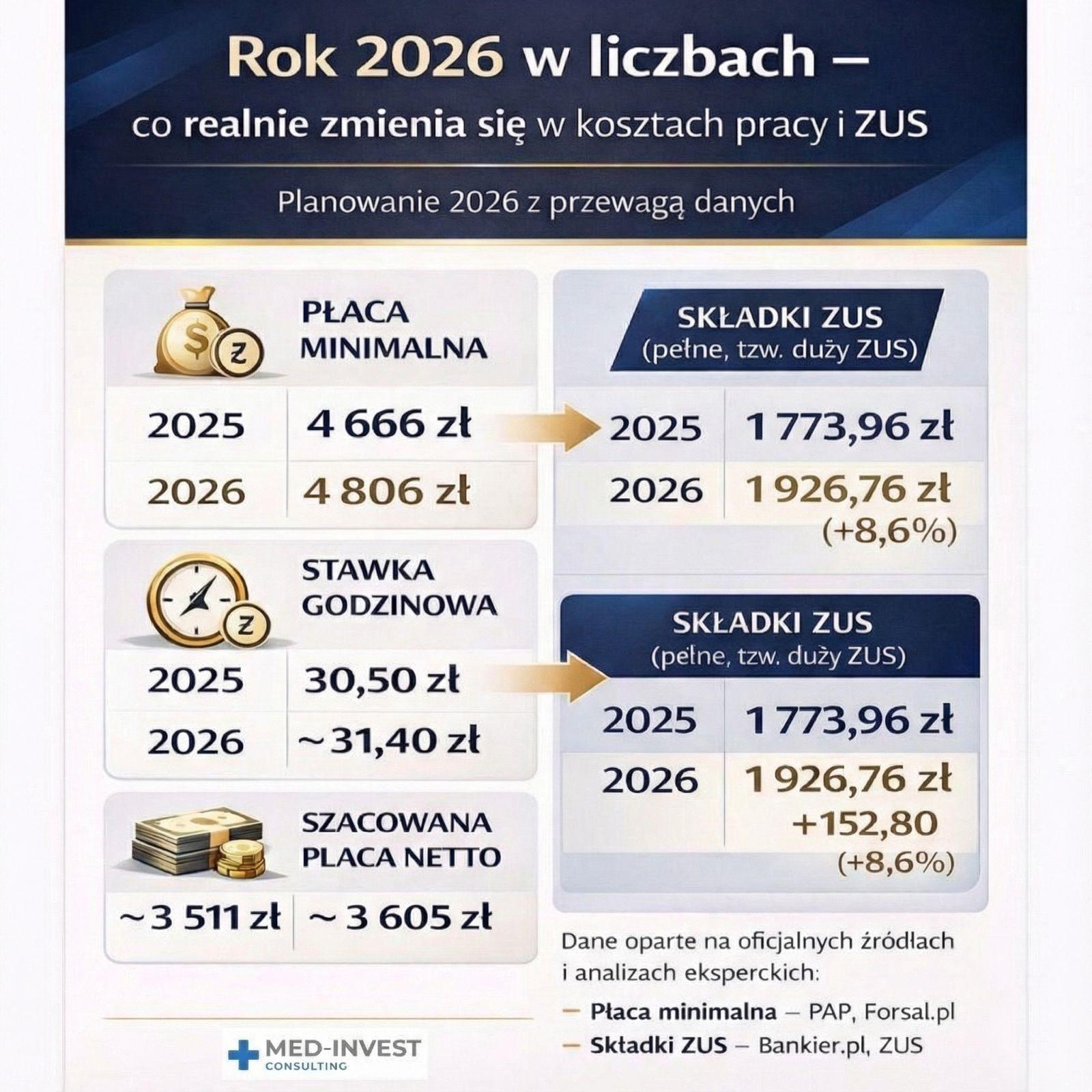
The year 2026 brings an increase in the minimum wage to PLN 4,806 gross, while social security contributions (ZUS) are rising by over 8% year-on-year. This is no longer just an HR challenge – it has become a real factor affecting purchasing and investment decisions. With inflation in 2025 around 4%, the real cost of labor is growing faster than in previous years.
Higher labor costs increase the pressure on efficiency and process control across teams and projects. Automation, digitalization, and AI in repetitive processes are becoming increasingly important.
In practice, labor costs impact areas such as:
– project profitability
– Make-or-buy decisions
– Procurement and investment strategies
– Implementation of automation and technology investments
Practical actions for companies looking to stay competitive and control costs:
1. Identify where money is leaking.
Take a close look at labor costs and end-to-end processes, especially cost-heavy areas. This helps quickly pinpoint opportunities for improvement and savings – without compromising quality.
2. Look beyond the “lowest price”.
Purchasing decisions should not be based solely on the cheapest supplier. Consider efficiency and return on investment (ROI) – how a decision supports long-term growth and impacts scalability.
3. Negotiate contracts with suppliers.
Regularly review supplier agreements, at least once a year, and negotiate terms. Flexible contracts that can respond to changes – inflation, raw material prices, or service costs – protect the company from sudden cost increases.
4. Leverage automation and AI.
Where repetitive tasks exist, implementing automation and intelligent tools can reduce labor costs, speed up operations, and lower the risk of errors. For companies that haven’t yet adopted any tools, 2026 is the perfect time to introduce improvements.
5. Make data-driven decisions.
Rather than relying on intuition, analyze different scenarios and anticipate, for example, a 10% increase in costs in budgets. This ensures purchasing and investment decisions are more informed, reducing exposure to unexpected expenses.
6. Plan for different scenarios.
Prepare strategies to respond to changes during the year. Risk- and opportunity-based planning, including the adoption of optimization tools, helps companies react quickly and maintain operational flexibility.
Result: better cost control, greater agility in operations, and smarter investment decisions. Companies that adopt flexible approaches not only save money but also gain a competitive advantage in the market.